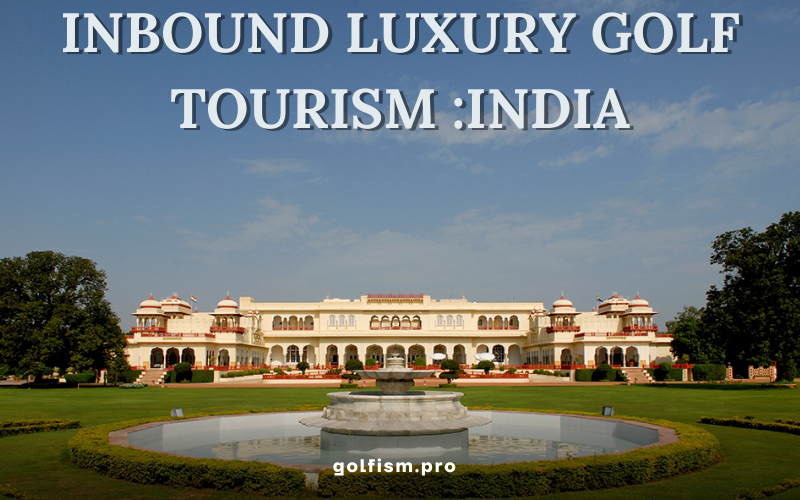
As 2025 draws to a close, India’s tourism sector is witnessing a record-breaking surge in high-value inbound arrivals. Moving beyond the “Revenge Travel” era, 2026 is being defined by Intentional Luxury. For the global golfer, India has emerged as a primary destination for “Passion-Cations” trips, where the hobby leads the itinerary, and heritage-linked experiences provide the emotional core of the stay.
1. The Revenue Landscape: High-Yield Arrivals
India’s golf tourism market is projected to reach $721.3 million by 2030, with a steady 11.1% CAGR starting from 2025.
- The Spend Factor: While India accounts for 1.5% of the global golf tourism market volume, its revenue-per-visitor is among the highest in Asia. International golf travelers in India spend an average of $650+ per day, with 58.6% of total sector revenue now generated by the international segment.
- The “UK-India” Corridor: In 2026, UK travellers are increasingly choosing India over Southeast Asian competitors. The draw is the “Lived-In Luxury,” a combination of familiar language, historical depth, and a slower, more curated pace of play in the Golden Triangle (Delhi-Agra-Jaipur).
2. Heritage Golf: The Competitive Edge
While Thailand and Vietnam lead in “volume,” India’s unique selling proposition (USP) for 2026 is Heritage.
- The Royal Circuit: Rajasthan is leading this charge by developing international-standard courses in Udaipur and Jodhpur. These are bundled with stays at restored palaces like The Leela Palace Jaipur or Rambagh Palace, where the golf is an extension of the royal experience.
- The 19th Century Appeal: Inbound travelers from mature markets (UK, US, and Australia) are specifically seeking out India’s historic clubs, such as the Royal Calcutta Golf Club (est. 1829). These “Legacy Rounds” are perceived as “unrepeatable” experiences that cannot be replicated in newer golf hubs.
3. The “Stay & Play” Infrastructure Boom
The supply-demand mismatch in India’s luxury hotel sector is protecting pricing power for golf-integrated resorts.
- Occupancy & Rates: Luxury hotel occupancy is stabilizing at a healthy 74–75% for 2026, with revenues projected to grow 13–14%. Resorts with championship courses, such as The Lalit Golf & Spa Resort Goa and ITC Grand Bharat, are reporting premium ADRs (Average Daily Rates) due to their “all-in-one” ecosystem.
- New Inventory: Key luxury signings like the Radisson Collection (Q2 2026) and Waldorf Astoria (2027) are anchoring their value propositions around exclusive “Passion-Cation” packages that include golf, Ayurveda, and culinary chef’s tables.
| Destination | Preferred Experience | 2026 Trend |
| Delhi NCR | Urban Championship Play | Multi-day “Stay & Play” at ITC Grand Bharat |
| Rajasthan | Heritage & Royal Golf | Sunset rounds at Rambagh, Jaipur |
| Goa | Coastal Beach & Boutique Golf | Integrated wellness retreats at The Lalit |
| Kashmir | High-Altitude “Himalayan” Golf | Scenic rounds at Royal Springs, Srinagar |
4. Logistics: The “Jewar” & “UDAN” Catalyst
The biggest barrier to Indian golf tourism accessibility is being dismantled in 2026 by massive infrastructure CAPEX.
- Aviation Impact: The operationalization of the Noida International (Jewar) Airport has created a direct luxury funnel into the NCR golf corridor, bypassing the congestion of central Delhi.
- Regional Connectivity: The UDAN scheme has made “multi-hub” golf trips (e.g., Delhi-Srinagar-Jaipur) viable for short-stay travelers. A 6-day itinerary that includes three distinct geographical zones (mountain, city, desert) is now a top-selling package for 2026.
5. Strategy for 2026: “Meaning over Opulence”
The 2026 luxury traveler is “becoming fatigued with generic gloss.” To capture this market, Golfism Pro recommends focusing on:
- Hyper-Personalization: Using AI to customize itineraries based on a golfer’s handicap, dietary preferences, and interest in local history.
- Multigenerational Packages: 71% of luxury travelers are planning multi-gen trips in 2026. Golf resorts that offer “Junior Academies” alongside “Ayurvedic Spas” for non-golfers are seeing 30% higher booking values.
- The “Slow Play” Movement: Encouraging longer stays (7-10 days) that blend golf with deep cultural immersion, rather than high-frequency “course hopping.”
Summary
December 2025 marks the transition of India into a mature luxury golf market. By leaning into its heritage assets and leveraging new infrastructure, India is no longer just an “alternative” to Thailand; it is a primary destination for the world’s most discerning travellers. India is now a primary destination for luxury golf experiences.